Engineering
Table Tennis Trainer Robot Arm
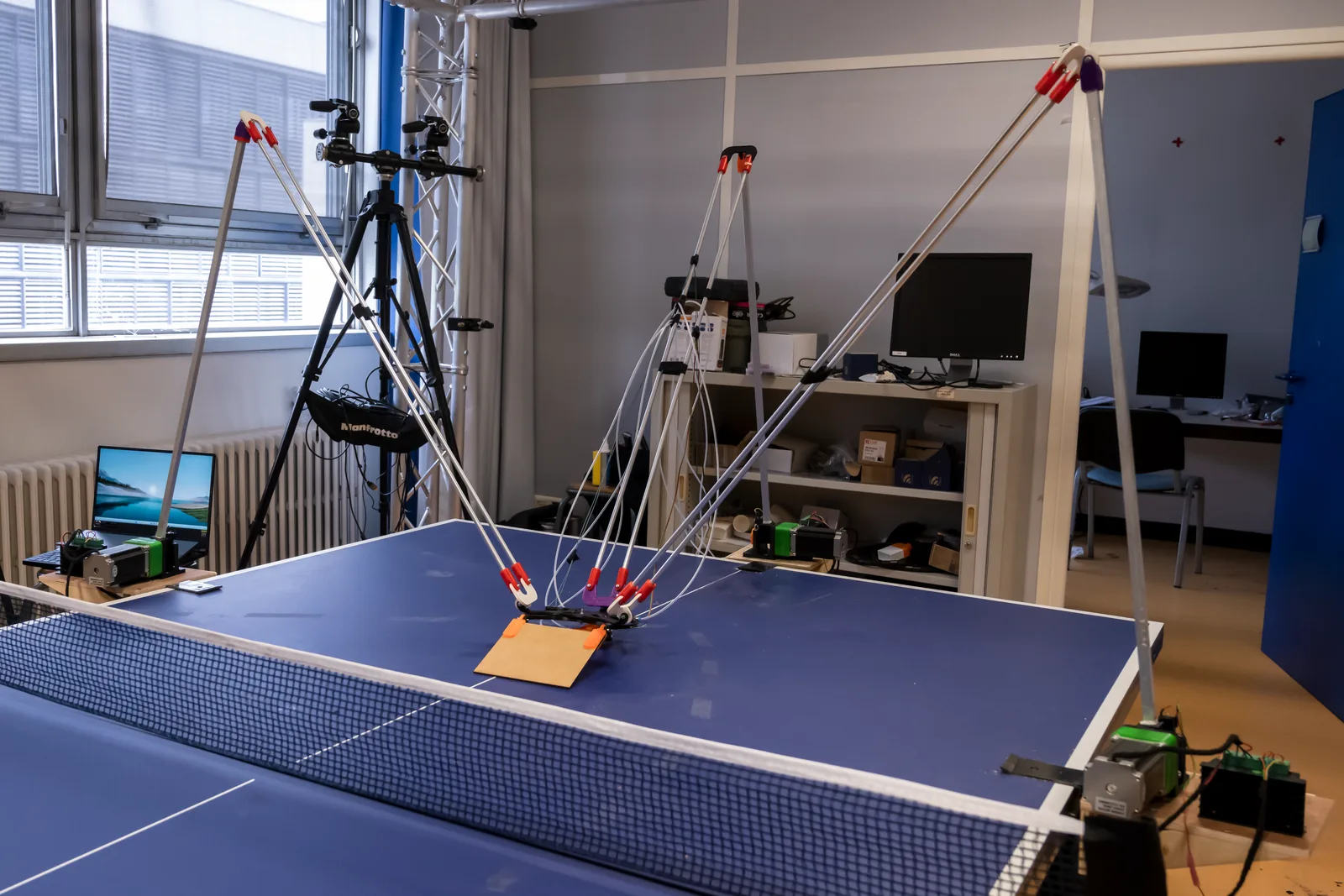
A Delta-architecture robot arm built as a table tennis training partner for the LIRIS laboratory — fast and precise over the table, swinging a cable-driven bat on pre-computed trajectories.
- engineering
A proof of concept, end to end
Financed by the LIRIS laboratory at Centrale Lyon, from an idea initiated by Romain Vuillemot, this robot was built to answer one question: can an arm train a human at ping pong? The write-up doubles as a complete walkthrough of designing a robot — picking a topology, inverse kinematics, motor and reduction sizing, payload design, electrical harness, 3D-printed parts, and control.
From SCARA to Delta
The numbers set the shape. To cover the table and reach the receiving position in the ~500 ms between hits, the payload has to move at roughly 7 m/s, while the bat sweeps −45° to 45° horizontally and 45° to −20° vertically. A first SCARA attempt put the elevation actuator in the payload and was simply too heavy — no motor could handle the inertia. Switching to a Delta parallel architecture moved the motors onto the base and left the moving mass minimal. Each arm is driven by a NEMA 23HS41-1804S stepper through a cycloidal reduction, after belt-pulley stages at 1:3.33 and 1:5 kept failing at the tensioner.
Cable-driven bat, feedforward control
The bat itself is the interesting part: two cable-driven actuators — one rotating the payload left to right, one tilting the bat — using Kevlar string for stiffness, tensioned by a twisted iron wire, with end stops for referencing. An Arduino Mega runs the inverse kinematics and fail-safes directly on the controller; with no feedback sensors, the robot is driven feedforward like a CNC or 3D printer, and swings are pre-determined trajectories triggered by the sound of the ball. In testing it proved precise but offset — correctable with a lookup table — and fast enough, though the simple command law left it vibrating and slow to settle.