Engineering
DIY Taiko no Tatsujin Arcade Controller
A step-by-step build for a full-size wooden replica of the Taiko no Tatsujin arcade drum — four piezo sensors under a rubber skin, an STM32 posing as a USB controller, for about €115 and three afternoons.
- engineering
Bringing the arcade into a dorm room
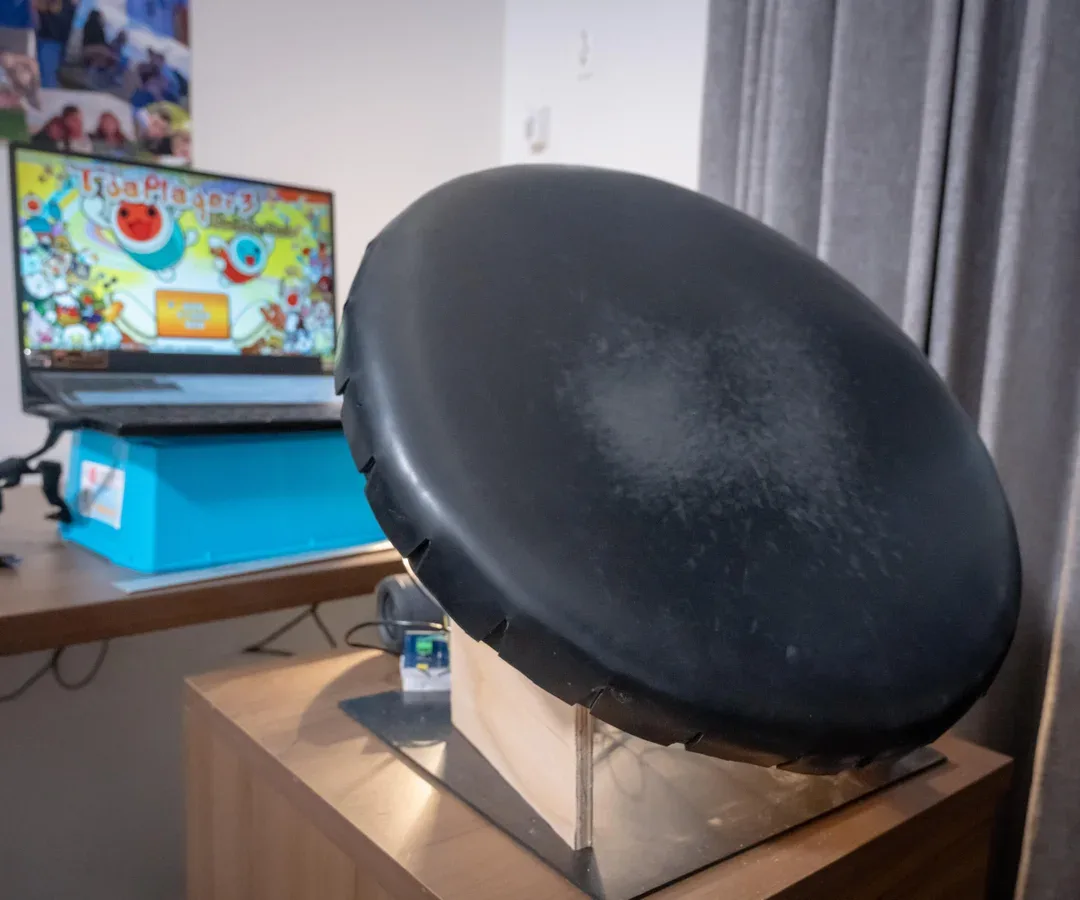
Two months into living in Japan and hooked on downtown arcades, the obvious next step was building a taiko drum for the dorm. The replica matches the real cabinet’s dimensions, and Japanese friends who played it said it feels close to the arcade. It is deliberately accessible: near-zero electronics knowledge, basic wood-cutting skills, around 12 hours across three afternoons, and roughly €115 all in — €80 without the general-purpose tools and consumables. The article is an expanded version of the original Instructables entry, with build feedback added.
Wood, rubber, and four buttons
The whole body comes out of two 12 mm planks. One becomes a 21 cm-radius mount plate; the other is halved and cut along a 182 mm radius to yield the four button plates — two inner, two outer, sanded in pairs so they stay symmetrical. Rubber damping blocks on M4 wood inserts float each button, and a hand-cut 3 mm rubber sheet with glued flanges and a 30 mm strip forms the drum skin. Everything is doable by hand with a jigsaw and clamps; SVG files are provided for anyone with a CNC.
Piezos, STM32, and an open-source game
Each of the four plates carries a piezo-electric sensor glued flat to the wood: the two centre plates fire the game’s red “don” notes, the two outer ones the blue “ka”. Wiring is as simple as it gets — every sensor’s ground to the MCU ground, each signal to its own analog input, with a 1 MΩ resistor to ground if the sensor comes without its little breakout board. An STM32F103C8T6 (flashed over an FTDI adapter, via STM32Duino) turns the drum into a USB HID device. Play it with TJAPlayer3, free and open source, plus charts from community TJA song lists. It holds up to rolls and heavy play.