Engineering
TSAL — Formula Student Tractive System Active Light
A full design breakdown of the Tractive System Active Light — the fully analog, fail-safe safety board that tells anyone near a Formula Student car whether its high-voltage system is live.
- engineering
What the TSAL is
The TSAL (Tractive System Active Light) is the mandatory Formula Student board that tells anyone near the car whether the high-voltage tractive system is dangerous. It carries two indicators: a red light that flashes whenever the DC-link capacitor poles sit above 60 V DC, and a green light that may only be on when every power relay is open — precharge and both AIRs — and less than 50 V is detected on the vehicle side inside the accumulator. The board was designed against the FSG 2023 rules.
Latching, and why the rules demand it
The green light must never mislead someone into thinking a live car is safe. Walk through the failure cases one at a time and two of them stay invisible at start-up: an AIR signal stuck open, and a voltage-detect signal stuck low. Closing those holes is exactly what rules EV4.10.13 and EV4.10.14 are for. The fix is to compare each relay’s actual state against its intentional state coming from the VCU — signals that are SCS-compliant, so a short to ground, a short to supply or an open circuit is itself detectable. Two truth tables turn that comparison into fault detection, one for the relays and one for the voltage sensing. Once a fault latches the light down, only a low-voltage power cycle clears it.
An all-analog board you can read at a glance
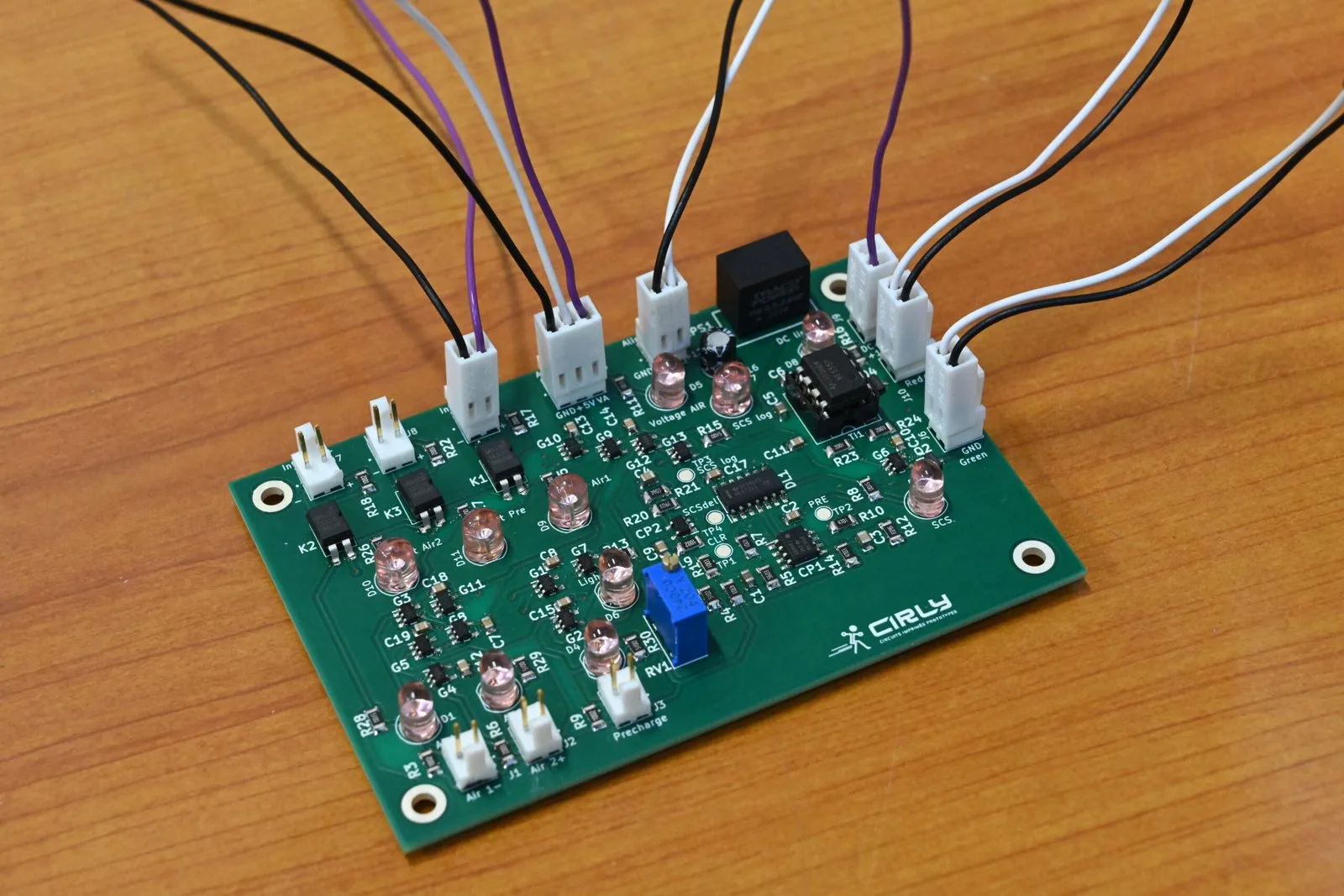
Everything is discrete logic — no microcontroller. The red light is timed by an NE555 driving an NMOS straight into the LED, kept entirely separate from the green side. The green side ANDs its four safe-state conditions and gates them through an automotive D-latch, with an adjustable delay so a momentary misread doesn’t trip the latch. Diagnostic LEDs expose every internal signal — latched, light condition, fault detected, each relay, its intentional state, both voltage comparators — so the board can be debugged at a glance. The post ships the KiCad project and the bill of materials for a real team to build on.